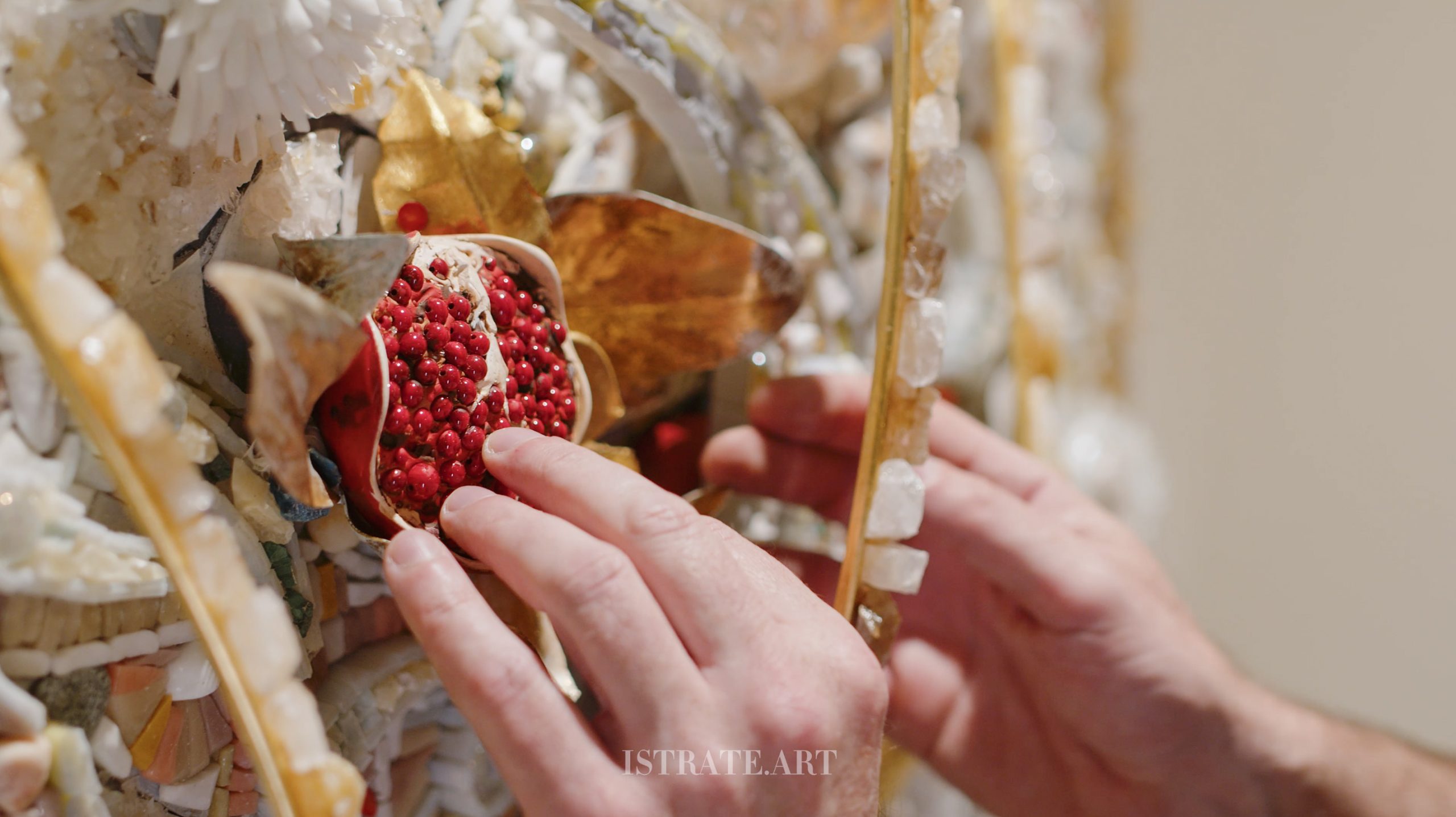
Journeying between the sublunary world and the earth, the goddess of the seasons, Persephone, lives six months a year, in autumn and winter, in hell, alongside Hades. The chromatics of the work suggests the solar life of Persephone, who, during the summer, revives nature and defies the infernal world. It also suggests the ancestral moment when, gathering flowers alongside the oceanids, at the foot of Nysei, she was kidnapped by Hades. The red stones recall the legend that Persephone became attached to Hell by eating an enchanted pomegranate seed. The cult of Persephone, shared by Boethia, the Peloponnese and Sicily, is emblematic for the spirits that cannot leave the obscure universe of sin and darkness after they had the food of within the Underworld.